
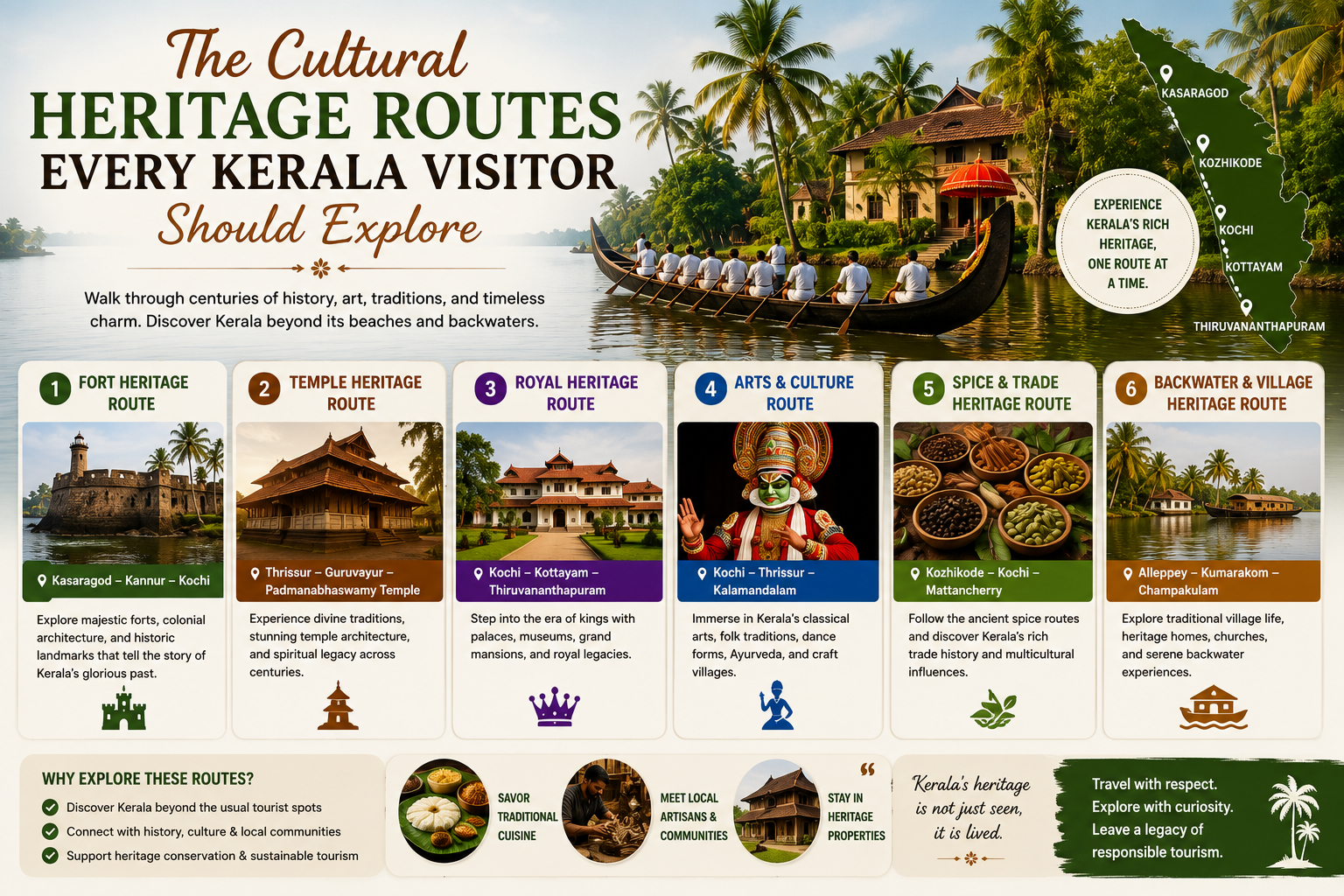
Kerala’s cultural heritage routes are among the richest travel experiences in Asia. Whether you are a first-time visitor, an NRI returning home, a family planning a meaningful holiday, or an international traveller looking beyond beaches and backwaters, Kerala’s living corridors of history, art, faith, and food offer something that no other destination in India can match.
The challenge is knowing where to go, in what order, and how to get there without wasting days on poor logistics. This guide maps every major heritage route across Kerala, from the multi-faith quarter of Fort Kochi to the ancient spice trails of Malabar, the classical arts heartland of Thrissur, and the sacred ritual landscapes of Kannur, so you can plan your trip with clarity and confidence.
Why Kerala Heritage Tourism Places Stand Apart
Most destinations in India offer either natural beauty or historical monuments. Kerala offers something rarer: a place where history is still alive in daily practice.
You can walk from a 400-year-old synagogue into a Portuguese colonial church, past a 14th-century mosque, and arrive at a temple with murals painted in the 1st century, all within a few kilometres. The art forms are still performed. The festivals still draw hundreds of thousands of devotees. The fishing communities still cast Chinese nets into the same harbour waters they have used for five centuries.
Kerala heritage tourism places are not archives. They are living, breathing expressions of a civilisation shaped by trade, migration, faith, and art across more than two thousand years. That is what makes every heritage route here genuinely different from anywhere else.
The state stretches 580 kilometres from Kasaragod in the north to Thiruvananthapuram in the south. Each region carries its own distinct cultural identity. Covering them all demands thoughtful planning, a reliable Kerala taxi service, and enough time to slow down and absorb what you find.
Route 1: The Fort Kochi Cultural Walk — Where Kerala’s History Begins
The Multi-Faith Heritage Quarter of Ernakulam District
Every heritage journey in Kerala starts at Fort Kochi. This small peninsula in Ernakulam district compresses over 500 years of global trade history into a few walkable kilometres, making it the single most information-dense heritage zone in the state.
Begin at the iconic Chinese fishing nets on the harbour front. These cantilever nets, introduced to Kerala by Chinese traders during the era of Kublai Khan, have been cast into the same waters for over 500 years and remain in active daily use by local fishing families.
Walk south to St. Francis Church, the oldest European church in India, built by Portuguese Franciscan friars in 1503. Vasco da Gama, who first landed in Kerala in 1498, was originally buried here before his remains were taken back to Lisbon. The church still stands, holds regular services, and carries the original gravestones of early European settlers in its floor.
The Dutch Palace in Mattancherry, also called Mattancherry Palace, was built by the Portuguese around 1555 and later renovated by the Dutch. Its interior walls carry some of the finest Kerala mural paintings in existence, depicting scenes from the Ramayana and Mahabharata in colours still vivid after nearly 500 years.
A short walk from the palace brings you to the Paradesi Synagogue, built in 1568 and one of the oldest active synagogues in the Commonwealth. The Jewish community that built it arrived in Kerala over 2,000 years ago. The synagogue’s interior, with its hand-painted Chinese floor tiles and Belgian glass oil lamps, is remarkable.
Fort Kochi is also the permanent home of the Kochi-Muziris Biennale, one of Asia’s largest contemporary art events, which transforms heritage buildings across the neighbourhood into a global conversation between ancient culture and modern creativity every two years.
Practical Tips for the Fort Kochi Heritage Walk
The full heritage walk covers roughly 3 to 4 kilometres. Start by 7 AM to beat the heat and arrive at sites before tourist crowds build. Most heritage buildings open by 9 AM.
Families and couples arriving by air at Cochin International Airport can book a direct airport taxi service in Kochi with Kerala Dayz to reach Fort Kochi without the confusion of finding transport on arrival. Our drivers drop you directly to your hotel in the heritage quarter so your first morning is already organised.
Route 2: The Muziris Heritage Circuit — Tracing the Ancient World’s Greatest Spice Port
Why Muziris Is the Root of Kerala’s Recorded History
If Fort Kochi is the beginning of documented heritage, Muziris is its ancient root. The port of Muziris, now identified with the Kodungallur and Paravur-Pattanam region of Thrissur district, was once the most commercially significant port in the known world.
Ships from Rome, Egypt, Arabia, and the Far East anchored here to trade pepper, cardamom, ivory, and textiles. Museris, as the Romans called it, appears in ancient Tamil Sangam poetry, Roman trade documents, and medieval Arab travel writings alike. It was here that Kerala’s Jewish community first arrived over two millennia ago. It was here that the Apostle Thomas is said to have landed in 52 AD, establishing Christianity in India generations before it reached most of Europe.
The government-supported Muzris Heritage Project has developed over 25 heritage sites across this region into a connected circuit. Key stops on the route include:
The Cheraman Juma Masjid in Kodungallur, considered one of the oldest mosques in India and said to have been built in 629 AD. The Kottapuram Fort, a waterfront Portuguese fortification built in 1523. The Pattanam archaeological excavation site, where ongoing digs have yielded Roman amphorae, Chinese ceramics, ancient coins, and pottery from across the ancient world, providing physical evidence of the port’s global reach. The Paravur Synagogue, which served the ancient Jewish community that settled here long before the famous Paradesi Synagogue was built in Mattancherry. The Thrissur Vadakkumnathan Temple, a classical Kerala Shiva temple with stunning mural paintings inside and the grounds where the iconic Thrissur Pooram elephant festival is held each year.
Getting Around the Muziris Circuit
The Muziris Heritage Circuit spans roughly 80 kilometres across Ernakulam and Thrissur districts. Public transport connects the larger towns but cannot efficiently cover the full circuit in a single day, and several of the most interesting minor sites, like the Pattanam dig and the Paliam Heritage Museum, are not well-served by buses.
Most heritage travellers find Kerala taxi packages the most practical option for this circuit, allowing full flexibility to stop at every minor site and spend more time at the archaeological zones. Kerala Dayz offers customised taxi packages for the Muziris circuit as either a full-day trip from Kochi or as part of a wider multi-day Kerala heritage itinerary.
Route 3: The Kathakali and Classical Arts Trail — Thrissur and Central Kerala
Immersive Cultural Experiences in Kerala’s Art Heartland
Kerala’s classical performing arts are not side attractions for tourists. They are the core of this state’s intangible heritage, preserved through centuries of dedicated training in specific communities and institutions.
Kathakali is the most internationally recognised of these art forms. A classical dance-drama performed in extraordinary costumes and dramatic facial makeup called chutti, Kathakali tells stories from the Ramayana and Mahabharata through pure physical expression. The facial makeup alone takes several hours to apply, using natural pigments to transform the performer’s face into an iconic character. A full traditional Kathakali performance runs through the night, though accessible evening presentations are available in Kochi, Thrissur, and Thiruvananthapuram.
Mohiniyattam is Kerala’s classical feminine dance, quieter and deeply lyrical. Named after Mohini, the feminine avatar of Vishnu from Hindu mythology, it is characterised by swaying movements that evoke the grace of the coconut palm and the flow of water. Performances are most accessible in Thiruvananthapuram and Thrissur, where major cultural institutions regularly host recitals.
Koodiyattam, the ancient Sanskrit theatre form from Kerala, holds the distinction of being the first performing art in the world recognised by UNESCO as an Intangible Cultural Heritage. It is performed inside temple theatre halls called kuttampalams, and full performances by trained hereditary practitioners are among the most remarkable artistic experiences available anywhere in India.
Thrissur is the cultural capital of Kerala for good reason. The Kerala Kalamandalam in Cheruthuruthy, a deemed university for traditional arts, the Kerala Sangeetha Nataka Akademi, and the annual Thrissur Pooram festival all converge here to make this district the single richest zone for classical arts immersion in the state.
Visiting Kerala Kalamandalam
The best way to experience Kerala’s classical arts is to combine an evening performance with a daytime visit to Kalamandalam. The campus welcomes visitors and offers guided tours where you can watch students in formal training across Kathakali, Mohiniyattam, Koodiyattam, Thullal, and percussion arts.
Watching a Kathakali student spend two hours applying makeup before a training session is a completely different experience from watching a 45-minute hotel lobby performance. If you are serious about understanding this art form, Kalamandalam is where that understanding begins.
Large family groups or tour parties travelling to Thrissur for the arts circuit can book a tempo traveller rental in Kochi to travel together comfortably from Ernakulam to Thrissur and back in a single day without the logistical complexity of managing multiple vehicles.
Route 4: The Theyyam Ritual Trail — Kannur and Kasaragod
One of the Most Powerful Living Heritage Experiences on Earth
If you visit Kerala between October and April and are anywhere near Kannur or Kasaragod, witnessing a Theyyam ritual takes precedence over almost everything else on your itinerary. There is genuinely nothing like it anywhere else in the world.
Theyyam is a ritual performance in which a trained practitioner from a specific hereditary community becomes the physical embodiment of a deity or ancestral spirit. Preparation involves hours of elaborate costume-making using natural materials and painstaking makeup application. When the performance begins, usually from midnight through dawn in an open courtyard called a kavil, the performer is no longer considered human. Devotees come for blessings, weeping and praying, fully believing they stand in the divine presence.
The scale, fire, percussion, colour, and emotional depth of a Theyyam performance is almost impossible to convey in words. It must be witnessed.
Theyyam is not a staged performance for tourists. It happens in village sacred groves connected to specific deities, and the timing follows the ritual calendar of that particular temple. The season in Kannur and Kasaragod runs from November through March.
Key Theyyam experiences across the Malabar heritage trail include:
The Parassinikadavu Sri Muthappan Temple near Kannur, where Theyyam is performed every single day throughout the year, making it the most reliably accessible Theyyam experience in Kerala. Village temples across the Kolathunadu region of Kannur, where dozens of individual Theyyam rituals are performed throughout the season at kaavus accessible to respectful visitors. The Kottiyoor Temple in Kannur’s highland region, famous for a specific seasonal festival. Bekal Fort in Kasaragod, which rounds out the northern Malabar circuit as the largest and best-preserved fort in Kerala, overlooking the Arabian Sea from a dramatic headland.
Getting to Theyyam Sites Safely
Theyyam rituals begin in the middle of the night, often in village locations that require navigating dark rural roads. International tourists and NRI families who are unfamiliar with the area genuinely need a knowledgeable driver who understands the Malabar region and can navigate both the physical roads and the social customs around entering these ritual spaces.
Kerala Dayz provides a dedicated pilgrim taxi service for temple and ritual travel across northern Kerala, including the Theyyam circuit in Kannur. Our drivers are locally familiar with Theyyam schedules, kavil locations, and the practical requirements of overnight temple travel, which makes a significant difference when you are following a ritual calendar rather than a fixed tourist route. Read more about Kochi taxi services for international tourists if you are planning your Kerala trip from abroad.
Route 5: The Malabar Spice Route — Kozhikode to Wayanad
Following the Flavours That Connected Kerala to the World
The spice route history that made Kerala the most commercially valuable coastline in the ancient world begins properly in Kozhikode, the city the Arab traders called Calicut. This is where Vasco da Gama first stepped ashore in 1498, completing the sea route that would transform global trade for the next three centuries.
Kozhikode city itself is worth a full day of heritage exploration. The Kuttichira Mosque quarter, with its ancient Mischkal Mosque and Muchundippalli mosque built by Arab traders in the 14th century, is one of the most authentic surviving examples of the cultural synthesis that the spice trade created. The Calicut Beach area and the lighthouse mark the historic landing point. The Pazhassiraja Museum and the Kozhikode Museum together document the region’s trading, colonial, and resistance history.
From Kozhikode, the heritage trail moves inland to Wayanad, where the cardamom and pepper plantations that drove the entire ancient global trade are still actively cultivated. Walking through a working cardamom estate in the Western Ghats, understanding the cultivation process, and connecting it mentally to the medieval trade routes that carried these spices to Rome, Alexandria, and Baghdad is a genuinely revelatory experience.
Wayanad also holds a distinct tribal heritage with the Kurichiya, Kuruma, and Paniya communities preserving oral traditions, craft practices, and ritual knowledge that predate the spice trade entirely. Several heritage tourism initiatives in Wayanad now offer respectful, community-hosted cultural experiences that add real depth to any visit.
The Malabar spice route trail also connects naturally with the culinary heritage of the region. Kozhikode Halwa, made in the same shops along SM Street for over 200 years. Malabar Biryani, shaped by centuries of Arab influence on the Mappila Muslim community that grew from maritime intermarriage. Pathiri and seafood preparations unlike anything found in central or southern Kerala. Eating along the spice route is itself a form of heritage travel.
Route 6: The Backwater and Temple Circuit — Alappuzha, Kollam, and Thiruvananthapuram
Sacred Architecture, Waterways, and the Soul of Southern Kerala
The backwater region of central Kerala is best known for its houseboat experience on Vembanad Lake and the famous Alleppey canal network. But the district carries genuine heritage depth that most visitors overlook in favour of floating dinners and sunsets.
The Ambalappuzha Sri Krishna Temple, famous for its paal payasam tradition, the Chettikulangara Devi Temple, and the Champakkulam Moolam festival on the Pamba River all belong to this region. The backwater communities themselves, the coir workers of Alappuzha, the Chinese net fishermen of the lake villages, and the toddy-tapping communities that produce Kerala’s traditional palm wine, carry living folk traditions that trace back centuries.
A Kerala Dayz houseboat experience on the Alleppey backwaters combines authentic immersion in the waterway landscape with access to the temple towns along the canals, and is one of the most popular ways families and couples structure the central leg of a heritage trip.
Moving south through Kollam, the heritage trail picks up the maritime history of one of medieval Asia’s most important pepper trading ports. The Thangassery area in Kollam retains the ruins of a Portuguese fort and a lighthouse that has guided Arabian Sea shipping since the colonial era.
Thiruvananthapuram anchors the southern end of Kerala’s heritage routes with two experiences of extraordinary significance:
The Padmanabhaswamy Temple is one of the most important Vishnu temples in the Hindu world and one of the wealthiest religious institutions on earth. Built and expanded across a period of over a thousand years, its classical Kerala temple architecture, the elaborate Murajapam festival cycle, and the sheer antiquity of its continuous ritual tradition make it a genuinely unmissable heritage destination for anyone visiting southern Kerala.
The Padmanabhapuram Palace in the adjoining Kanyakumari district, historically part of the Travancore kingdom that governed much of Kerala, is the largest wooden palace complex in Asia. Its carved wooden ceilings, Chinese floor tiles, and Kerala architecture spanning five centuries represent the cultural height of the Travancore period.
Route 7: The Pilgrim Heritage Circuit — Sabarimala, Guruvayur, and the Temple Towns
Where Devotion and Architecture Converge
Kerala’s temple heritage is not confined to historical sites. Many of its most significant temples are active pilgrimage destinations drawing millions of devotees every year, and the experience of visiting during a major festival or pilgrimage season adds a living dimension that purely historical heritage cannot match.
Guruvayur Sri Krishna Temple in Thrissur district is one of the most visited temples in India, drawing over 50,000 devotees on peak festival days. The temple’s Guruvayurappan deity is considered one of the most powerful forms of Vishnu in the Hindu tradition, and the elephant sanctuary attached to the temple grounds is unique in India.
Sabarimala, the forest shrine of Lord Ayyappa in the Periyar Tiger Reserve in Pathanamthitta district, is one of the largest pilgrimage sites in the world. During the Mandalam-Makaravilakku season between November and January, millions of pilgrims make the challenging trek through the forest to the hilltop shrine. Kerala Dayz provides dedicated pilgrim taxi services for Sabarimala pilgrims across Kerala, including pick-up from Kochi, Ernakulam, and other major towns, with drivers experienced in the pilgrimage route logistics.
The Vadakkunnathan Temple in Thrissur, the Ettumanoor Mahadeva Temple in Kottayam famous for its Ashtami Rohini murals, the Chottanikkara Bhagavathy Temple in Ernakulam, and the Attukal Bhagavathy Temple in Thiruvananthapuram, which holds the Guinness World Record for the largest gathering of women at a single event, each represent different dimensions of Kerala’s extraordinarily rich temple heritage.
How to Travel Kerala’s Heritage Routes: Practical Planning Guide
Kerala’s geography works against the unprepared traveller. The state is long and narrow, with major heritage sites spread across every district from Kasaragod in the north to Thiruvananthapuram in the south. Public transport connects cities well enough, but cannot serve the village-level temple sites, rural heritage locations, Theyyam ritual grounds, and archaeological sites where Kerala’s most authentic and memorable experiences actually happen.
How Many Days Do You Need?
Here are practical itinerary frameworks based on the heritage routes above:
A focused 5-day heritage trip can cover Fort Kochi, the Muziris circuit, and Thrissur classical arts including an evening Kathakali or Koodiyattam performance.
A 7 to 10-day heritage itinerary can add the Malabar spice route through Kozhikode and Wayanad, plus the backwater temple circuit through Alappuzha and Kollam.
A full 12 to 14-day journey from north to south, covering Bekal and the Theyyam trails in Kannur down to Padmanabhaswamy Temple and Padmanabhapuram Palace in the south, is one of the most rewarding travel experiences available anywhere in South Asia.
Who Benefits Most from a Dedicated Heritage Tour Vehicle
A private vehicle with a driver who knows the territory is not a luxury on a Kerala heritage trip. It is the difference between accessing the real experience and missing it entirely. This is especially true for:
Families with children or elderly members who need comfort, flexibility, and the ability to stop when the mood calls for it rather than following a bus schedule. International tourists who are unfamiliar with Kerala’s road network, language, and the practical logistics of following a ritual calendar across multiple districts. NRI visitors returning for limited time who need to cover meaningful ground without logistical stress or guesswork. Couples and honeymooners who want unhurried, private access to each heritage experience rather than group tour timings.
Whether you need a sedan for a couple, an SUV for a family, or a larger vehicle for a group, Kerala Dayz taxi services cover all major routes across Kerala with experienced drivers who are locally familiar with heritage sites, temple schedules, festival timings, and Theyyam ritual calendars. For inter-district heritage travel across multiple days, our Kerala intercity taxi services offer the most flexible and cost-effective option for independent travellers and families alike.
Frequently Asked Questions About Kerala Cultural Heritage Routes
What is the best time of year to explore Kerala cultural heritage routes?
October to March is the ideal window for heritage travel in Kerala. The weather is dry and comfortable, the Theyyam season is fully active in Malabar, temple festivals including Thrissur Pooram in April fall at the season’s edge, and the Kochi-Muziris Biennale runs through this period. If you want to experience Onam, Kerala’s largest cultural festival with its full sadhya feast, snake boat races, and Pookalam flower carpets, plan your trip for August or September.
How many days do I need to cover all the major heritage routes in Kerala?
A focused short heritage trip covering Fort Kochi, the Muziris circuit, and Thrissur classical arts needs a minimum of 5 days. A more thorough journey covering Malabar, the Theyyam trail, the backwater temple circuit, and the southern pilgrimage route comfortably needs 12 to 14 days. Kerala Dayz can help design a custom heritage itinerary around your available time, travel pace, and specific interests.
Can international tourists attend Theyyam rituals and temple festivals?
Yes. Theyyam rituals are held in open temple grounds and sacred groves that welcome respectful visitors of all backgrounds. Most major Kerala temples also welcome international visitors to the outer precincts and festival events, though inner sanctum access varies by temple. Visitors should dress modestly, covering shoulders and knees, and follow local guidance on etiquette. Kerala Dayz drivers from the Malabar region can advise on current temple policies and upcoming Theyyam schedules in real time.
Are Kerala heritage routes suitable for families with young children?
Most heritage sites including Fort Kochi, the Muzris Heritage Project sites, Guruvayur, and the major temple complexes are very accessible for families and involve manageable walking distances. Theyyam rituals in village settings require overnight travel and outdoor waiting from late evening, which can be demanding for very young children but is manageable with preparation. A comfortable private vehicle makes a significant difference for families covering multiple heritage destinations over several days.
Is there a heritage route that combines culture and backwaters?
Yes. The central Kerala circuit combining Alappuzha backwaters with the temple towns of Kottayam and Pathanamthitta is the most natural fusion route. A houseboat overnight on Vembanad Lake gives you the backwater experience, and the surrounding temple towns, particularly the Ambalappuzha Sri Krishna Temple and the Ettumanoor Mahadeva Temple, add cultural depth. Explore the best Kerala tour taxi packages for families and couples on the Kerala Dayz blog to find an itinerary that works for your group.
Plan Your Kerala Heritage Journey with Kerala Dayz
Kerala’s cultural heritage routes span one of the most historically rich and culturally alive states in India. Whether you want to trace the ancient spice trade through Kozhikode and Wayanad, witness Theyyam in a Kannur village before dawn, walk the multi-faith quarter of Fort Kochi, follow the classical arts trail through Thrissur, or complete the pilgrimage circuit from Guruvayur to Sabarimala and Padmanabhaswamy Temple, the journey rewards every hour invested in it.
Getting the transport right makes all of it possible. Kerala Dayz connects families, couples, NRI visitors, and international travellers to the best of Kerala’s heritage destinations with reliable vehicles, experienced drivers, and service built around your itinerary rather than a fixed group tour schedule.
Explore our Kerala tour taxi packages to find a heritage circuit that matches your time and interests, or call us directly to plan a fully customised cultural heritage journey across God’s Own Country.